
This article sheds light on some aspects of political culture, governing and how information you receive relate to how you vote. It describes the current surge of populists, what democracy actually is, different types of regimes, where the governing power lies, why it is so hard to keep order in international affairs and last but not least why a life of politicians is tricky and what they have to cope with.
The article is based on a book Politics 6th edition by Andrew Heywood (link to a review) and my own observations of political landscape and behaviour of politicians.
Populists vs established politicians
There has been a huge rise in populists. Who is actually a populist? It is a person who tries to separate society into two warring factions. It is usually the ordinary/poor and the corrupt elite. They try to reach those who feel left behind by established political elites.
They usually promise a lot, turn themselves into a messiah but can’t deliver up to their promises.
When populists get elected, established elites and liberal media comment on it in a way that there is something wrong with the people who vote for them and that established elites are those who should carry on ruling.
I would rather look on causes of this which I think is more important. One of the reasons why voters vote populists is that they are not satisfied established political parties and elites. So, let’s define that populism is a direct consequence of how well established parties governed a country.
However, what I see in the media is tarnishing the public as stupid because they vote for populists. The right approach is for established elites to look at how they have governed and what they did wrong (reasons for not being voted again) and redress these shortcomings. Unfortunately, I have not seen established political elites to do so. Which means that the proportion of populists will rise until there is a change in a way established elites think.
Democracy and three branches of it
In a standard democratic state (democratic meaning people can vote and stand for elections themselves and elect and depose politicians each four/five years + voters have unrestricted access to information regarding who to vote). The power is separated in three branches:
- Legislatures – the people who introduce and make the law.
- Executives – the people who implement the law (budget, building roads, redistribution of money…)
- Judiciaries – They interpret the law, meaning that when there is a dispute among two parties, they make decision on where the “truth” lies.
If they are separate, it is good. However, imagine that the same person, an entrepreneur is a legislator, an executive and a judge in one person. He owns many factories built in areas with low wages where there are no transport connections. In order to prosper, he introduces a law to reduce taxes for himself (+ reduce the minimum wage) and a law which says that the state should build railroads to places where there are only his factories. As the executive, he sets aside money from a budget (consisting of public money) and make plans to build them. The only use of the railroads is to haul cargo from and to their factories.
The public doesn’t like it. They fill a lawsuit against them. They go to a trial and expect a judge to make a decision in this matter. However, it is the same person, the big entrepreneur and guess what. He adjudicates that it is not against the public interest. Well, why would he make a different decision, when it is their own personal interest to build the railroads for free from the public money.
That is the reason why these three branches must be separate in order to limit power of people and politicians to do as they please.
Where the power lies
There are multiple types of “where the power lies” after elections. It means that the power to choose a prime minister and nominate ministers/secretaries can be in the hands of a president (USA), in the hands of one party (United Kingdom) or in the hands of multiple parties (Czech Republic). It is hard to compare countries regarding where the power lies.
When the American president gets elected, he has the right to choose who their ministers/secretaries will be.
The second option is a parliamentary system. This can be further divided into:
- One party rules for the next 4 or 5 years,
- Multiple parties / a coalition rules for the next 4 or 5 years.
The a) is the case of the United Kingdom. The party which has more votes takes all the winnings. The winning party decides who will be the prime minister and ministries/secretaries.
The b) case is the case of the Czech Republic. It is called a directly proportional system. Seats in the parliament are divided among parties depending on the percentage of votes they receive. There isn’t usually a party having a majority of the seats. The party with a reasonable number of votes must be in a coalition with another party to have the majority (50%) of the seats in order to choose and confirm the prime minister and ministries / secretaries.
Dictatorship vs totalitarian regime
There are other types of regimes. One of them is a dictatorship and the second one is a totalitarian regime.
The dictatorship is a regime where a small group of people rules a state and their power is not restricted by the separation of power neither time-limited. There is usually suppression of opposition and lack of political freedom. The dictatorship also tries to look like democracy on the outside. Even though, they don’t actually solve internal socio-economic issues. The dictatorship doesn’t try to intrude upon personal lives of their citizens as long as they don’t try to overthrow the regime.
On the other hand, the totalitarian regime is a more extreme version of the former. It seeks to control every aspect of a life of their citizens: what they think, what they do, to whom they speak and so on.
The media and public opinion distortion
The media has very big influence on information citizens receive. People make decisions based on information they have. Which takes me to an idea that if the information you have is distorted/tampered, your decision is also distorted/wrong.
Example: Imagine you are in a closed room without windows (Or with LCD panels where anything can be screened and a person in the room is not aware of it). You are the person in the closed room. You must make a decision whether to go out depending on information you receive about a weather forecast. There is another person, an information giver. The person may give you information about the weather outside irrespective of the actual weather outside. If the information giver wants you to knit them a sweater in the closed room, they may tell you, the weather is bad outside (Even though it is not). You make a decision to stay inside contradictory to your own will and knit a sweater for the information giver based on the false information.
It is a very simplified situation. However, you can imagine that information you receive and you can verify has very big influence on your decisions. The media reports daily about politics and politicians. This information influences how and what we think about politicians and how we vote. Let’s ask ourselves what agendas and interests of the media are. It is really the public good or their self-serving interests? Their interests influence the way they inform the public.
Most privately-owned media in the Czech Republic have making a profit as their main target. The more readers read them, the higher value of advertisements for them. What makes people read news more? It is related to emotions. Strong emotions, especially the bad ones, make people read more and thus increase value of the media. Is this really in the interest of the public?
When you receive information from a party/person. Ask yourself what their reasons / agendas are to better understand the information received.
Rules and the global order
A state is an institution which has monopoly on violence. It has the right to coerce people to obey the law. That means that agreements and laws can be upheld within the border of the state.
Is it possible to do it among states? I have always wondered why UN resolutions are not observed/abided by. The main reason is there is not a body which would have a monopoly on violence in international affairs to coerce states to abide by agreements they agree on. This makes international space anarchy. It works more in a way that states obey international agreements because they are afraid of retaliations from other states.
That sheds some light on why bad things like wars, tariff wars are always happening among states.
Cultural wars
You may have seen things like: feminism, green people, me too campaigns, black live matters, LGBT, the ordinary vs the elite, the educated vs the illiterate, the ones who do this and the ones who do something else (Like wearing a different hat which must be taken off at different venues differently at different times of a day).
They are called cultural/ideological wars. The purpose is to separate people into multiple groups and let them fight between each other. What is it good for? Well, my personal opinion is that if you have people fighting over something, they can’t stick together and it is easier to rule them as well as leave matters which need scrutiny hidden.
I guess we, as civilization, should concentrate on what we have in common. The verb “to differentiate” has the same meaning as “to discriminate” between two and more sides. It creates discrimination which we have wanted to get rid of for a long time.
It is also interesting that such high-level ideas didn’t come to the surface so much in the past. It has something to do with welfare of society and the Maslow’s hierarchy of needs:
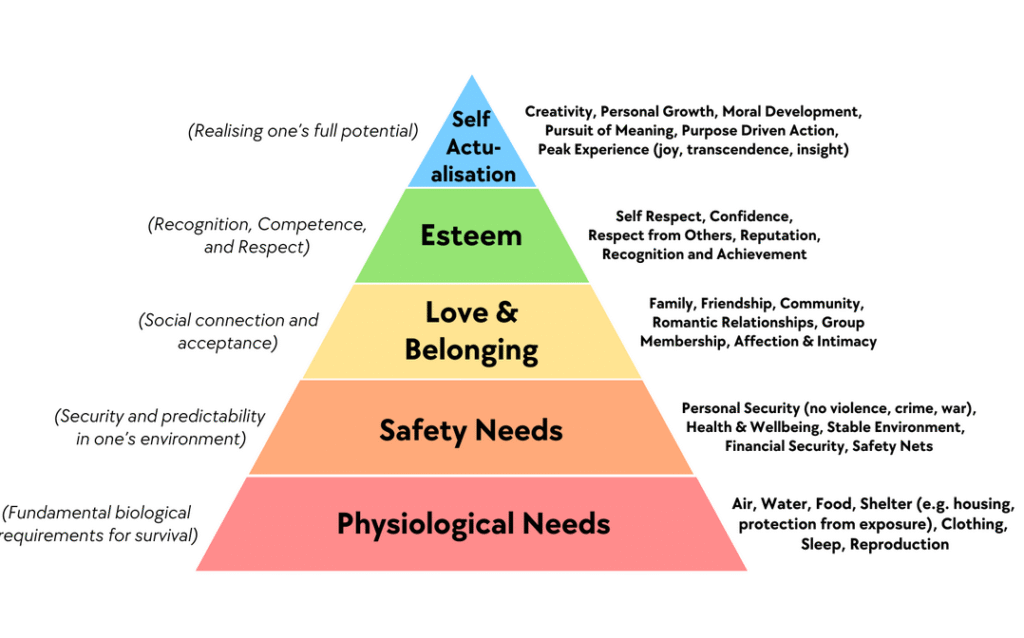
Once you fulfil the needs from the lower rung of the pyramid, you can move up to the higher one. The ideas mentioned above are the top of the pyramid. It makes me conclude that all our needs were fulfilled and we could start dealing with a different set of issues.
However, recently we can notice a reverse direction from these ideas back to safety and physiological needs. Are we going back as society?
Tricky life of politicians
A life of politicians can be tricky. They fight between four aspects. The aspects are:
- The need of being elected again and keep power,
- Self-serving interests and interests of pressure groups and lobbying,
- Public interests,
- What people want to hear and get irrespective of what’s good for the many or good in the long term.
From the purest point of view, the only legitimate aspect is to serve the public interest. Another one is to keep the post in order to carry on with their agenda (if good for the public).
The bad ones are when politicians do politics in order to serve their self-serving interests or do only what the public wants to hear and get. Many times, what the public wants to get (e. g. free ice-cream) isn’t actually good for them in the long term. That is the reason why a group of dentists should formulate the policy regarding the free ice cream act (Perhaps called Great Beautiful Amazing Ice-Cream Act -> It sounds good on TV). Otherwise, the public will die of sugar overdose and miss their teeth.
Conclusion
We have had a look at various aspects of political landscape. I have tried to explain and support my statements with arguments. The elections are coming in the Czech Republic. It is better that citizens understand the wider picture of what goes on, because we weren’t taught it at school.
What are your points of view on political culture? Add a comment below.